
The Great Wildebeest Migration: Witness One of Nature’s Most Spectacular Journeys
Every year, more than a million wildebeest move across the vast plains of East Africa, accompanied by hundreds of thousands of zebras and gazelles. Driven by seasonal rains, fresh grass, and an ancient instinct to survive, this extraordinary movement between Tanzania’s Serengeti and Kenya’s Maasai Mara is known as the Great Wildebeest Migration.
It is one of Africa’s most remarkable wildlife experiences. The sight of enormous herds stretching across the savannah, predators following close behind, and wildebeest gathering at riverbanks creates unforgettable moments for anyone fortunate enough to witness the journey.
The migration is not a single event that happens on one particular day. It is a continuous natural cycle that changes throughout the year. Calving season, long treks across the plains, predator encounters, and the famous Mara River crossings each offer a completely different safari experience.
In this guide, we explore when and where to see the Great Wildebeest Migration, what happens during each stage of the journey, the best areas for a migration safari, and how to plan your trip.
What Is the Great Wildebeest Migration?
The Great Wildebeest Migration is the annual movement of large herds of wildebeest through the Serengeti National Park in Tanzania and Kenya’s Maasai Mara National Reserve.
The herds are constantly on the move, following seasonal rainfall and the availability of fresh grazing. Although the route changes from year to year depending on weather conditions, the migration generally follows a broad clockwise pattern between southern Tanzania, the central and western Serengeti, the northern Serengeti and Maasai Mara, before eventually turning south again.
Wildebeest are joined by large numbers of zebras and gazelles, creating one of the greatest concentrations of grazing animals in Africa.
The journey is not without danger. Lions, cheetahs, leopards, hyenas and other predators take advantage of the abundance of prey, while crocodiles wait in some of the rivers the herds must cross.
For the animals, however, the migration is not a performance. It is a matter of survival.
How Far Do the Wildebeest Travel?
Individual animals can cover hundreds of kilometres during the annual migration, with the overall journey often extending across roughly 800 to 1,000 kilometres depending on the route and seasonal conditions.
The herds do not simply walk from Tanzania to Kenya and back. They spread across enormous areas, sometimes forming smaller groups before coming together again.
Their movement is largely influenced by:
-
Seasonal rainfall
-
Availability of fresh grass
-
Water sources
-
Temperature and local conditions
-
Natural instincts developed over generations
This constant movement allows the herds to access new grazing areas while spreading nutrients throughout the ecosystem.
When Does the Great Wildebeest Migration Happen?
One of the most important things to understand about the Great Wildebeest Migration calendar is that there is no guaranteed date for every stage.
Rainfall patterns vary from year to year, so the location of the herds can change. Nevertheless, the migration follows a general annual cycle.
January to March: Calving Season in Southern Serengeti
The year begins in the southern Serengeti and the Ndutu area, where large herds gather around nutrient-rich grasslands.
Between approximately January and March, the region becomes an important calving ground. Large numbers of wildebeest calves are born within a relatively short period.
For safari travellers, this is an incredible time to experience the migration. The plains are often green after seasonal rains, and young calves can be seen learning to walk and keep up with the herd.
However, the abundance of young animals also attracts predators.
Lions, cheetahs, hyenas and other carnivores take advantage of the concentration of vulnerable newborns, creating excellent opportunities for predator sightings.
Best for: Calving, predator action, photography and green landscapes.
April to June: Moving Through the Serengeti
After calving season, the herds gradually begin moving north and west through the Serengeti.
April and May can bring changing weather and greener landscapes, while the herds continue searching for fresh grazing.
By May and June, some groups reach the Western Corridor, where they encounter the Grumeti River.
The Grumeti area can provide spectacular wildlife viewing without always experiencing the same level of attention associated with the Mara River crossings.
Best for: Green landscapes, fewer crowds in some areas and following the migration as it moves north.
July to September: Northern Serengeti and Mara River Crossings
For many travellers, this is the most famous stage of the Great Wildebeest Migration.
As the dry season develops, large herds reach northern Tanzania and begin moving toward Kenya’s Maasai Mara.
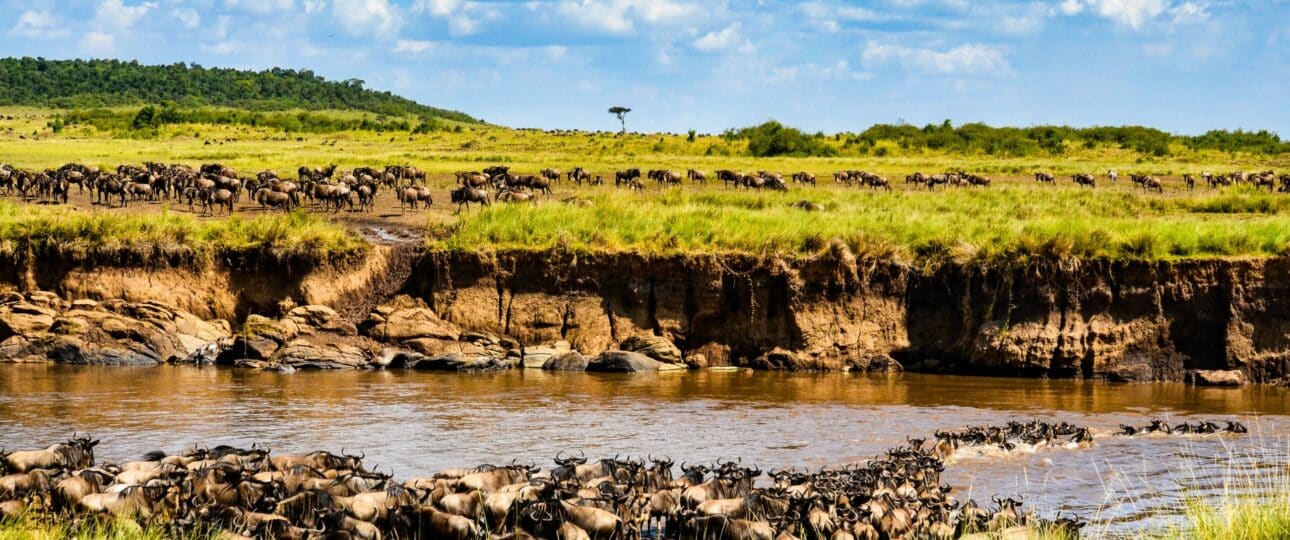
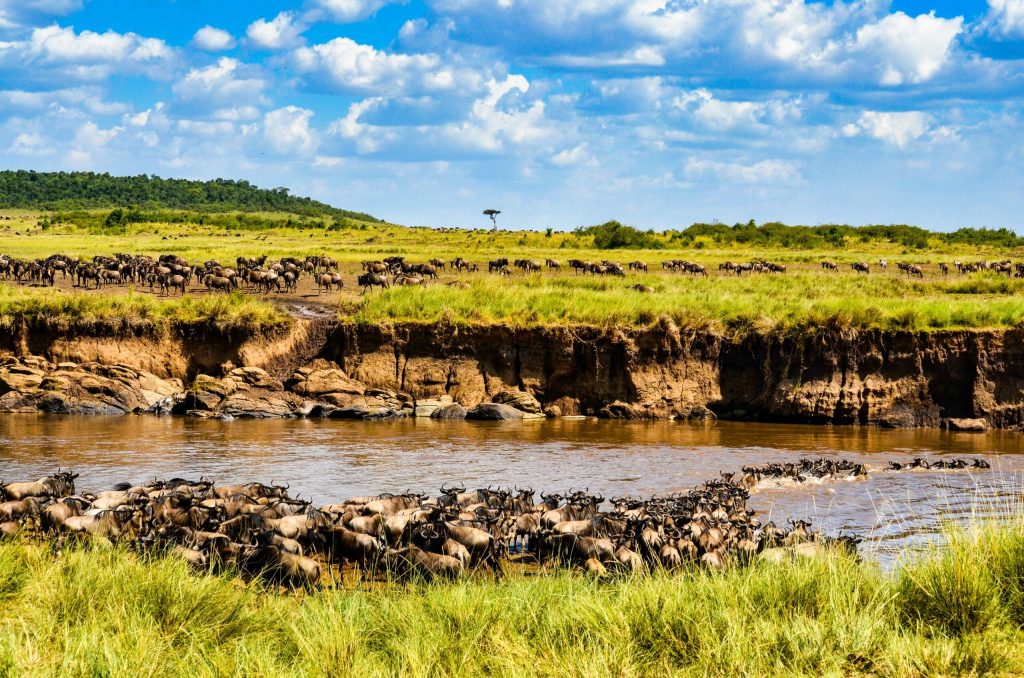
The Mara River crossings are unpredictable. Herds may gather at the riverbank for hours or even days before deciding to cross.
Then, suddenly, the movement begins.
Thousands of wildebeest can rush toward the water, creating an extraordinary scene of dust, noise and movement. Crocodiles inhabit sections of the river, while predators may wait nearby for opportunities.
However, river crossings should never be treated as guaranteed. The timing depends heavily on rainfall, river conditions and the behaviour of the animals.
Best for: Mara River crossings, dramatic wildlife photography and classic migration experiences.
October to December: The Journey Back South
After spending time in the northern Serengeti and Maasai Mara, the herds gradually begin moving south again.
The eastern Serengeti becomes an important part of the return journey as the animals follow new rainfall and fresh grazing.
By November and December, seasonal rains can transform the plains, encouraging the herds to continue toward the southern Serengeti.
Best for: Green scenery, moving herds, wildlife viewing and a quieter migration experience.
Where Is the Best Place to See the Great Wildebeest Migration?
There isn’t one single location that can guarantee the best migration experience. The ideal destination depends on what you want to see and when you are travelling.
1. Ndutu and Southern Serengeti
The Ndutu Plains are particularly important during the calving season.
The open grasslands provide excellent opportunities to see wildebeest with their young, along with zebras, gazelles and predators.
This is an excellent region for travellers interested in the beginning of the migration cycle.
2. Central Serengeti
The central Serengeti, including the Seronera area, offers excellent year-round wildlife viewing.
Even when the main migration herds have moved elsewhere, resident wildlife remains abundant.
This makes central Serengeti useful for safari itineraries that combine the migration with traditional Big Five game viewing.
3. Western Corridor and Grumeti River
The Western Corridor is an important part of the migration route, particularly around May and June.
The Grumeti River creates one of the journey’s natural obstacles and can provide dramatic wildlife encounters.
The region also offers a different landscape from the open plains of the southern Serengeti.
4. Northern Serengeti
Northern Serengeti is one of the key areas for travellers hoping to experience the migration between July and September.
The region provides access to areas around the Mara River while also offering excellent opportunities for general wildlife viewing.
5. Maasai Mara, Kenya
Kenya’s Maasai Mara is one of the most popular destinations for witnessing the migration.
When large herds enter the reserve, the open grasslands can become filled with wildebeest, zebras and gazelles.
The Mara also supports abundant resident wildlife, including lions, elephants, leopards, cheetahs and other species.
For travellers visiting Kenya, combining the Great Wildebeest Migration with a Maasai Mara safari can create an especially memorable experience.
Why Do Wildebeest Migrate?
The migration is primarily driven by the search for food and water.
Wildebeest depend heavily on seasonal grasslands. As rainfall changes across the Serengeti-Mara ecosystem, different areas become more suitable for grazing.
Rather than following a fixed calendar, the herds respond to environmental conditions.
This is one reason why predicting the exact location of the migration can be difficult.
A safari booked for a particular month may provide excellent opportunities to see the herds, but nature ultimately determines where the animals will be.
The Role of Predators in the Migration
Where there are large numbers of herbivores, predators are never far away.
The migration creates seasonal feeding opportunities for some of Africa’s most famous predators.
Lions may hunt wildebeest and zebras on the open plains. Cheetahs can take advantage of vulnerable young animals, while hyenas often follow the herds looking for opportunities.
Leopards generally remain more elusive, but may also be encountered in areas where the migration passes.
These predator-prey interactions are an important part of the ecosystem and are one reason migration safaris can produce such varied wildlife experiences.
What Makes the Mara River Crossings So Special?
The Mara River crossings have become one of the defining images of the Great Wildebeest Migration.
Yet what makes them fascinating is their unpredictability.
A herd can gather along the riverbank while thousands of animals wait. The wildebeest may move forward, retreat, gather again and suddenly cross.
When the crossing finally happens, the scene can be chaotic.
Dust rises from the riverbank, animals call to one another and hundreds or thousands of wildebeest may enter the water almost simultaneously.
Crocodiles are also present in parts of the river, adding another natural hazard to an already dangerous journey.
For photographers and wildlife enthusiasts, these moments can be extraordinary. But patience is essential because there is no reliable schedule for a river crossing.
How to Plan a Great Wildebeest Migration Safari
Planning your safari around the migration requires more than simply choosing a month.
Consider the experience you want before deciding where to go.
If your priority is seeing newborn wildebeest and predator activity, consider the southern Serengeti and Ndutu during the calving season.
If you want to experience the famous Mara River crossings, plan around the period when the herds are likely to be in northern Serengeti and Maasai Mara, generally from July to September.
If you prefer greener landscapes and potentially fewer visitors, other stages of the migration can provide rewarding experiences without focusing entirely on river crossings.
A knowledgeable safari operator can also help adjust the itinerary according to recent rainfall and reported herd movements.
What Should You Pack for a Migration Safari?
A migration safari involves spending considerable time outdoors, often in open vehicles and changing weather conditions.
Useful items include:
-
Lightweight, breathable clothing
-
A warm layer for early morning game drives
-
Comfortable walking shoes
-
Sun hat and sunglasses
-
Sunscreen
-
Binoculars
-
Camera and spare batteries
-
Extra memory cards
-
Insect repellent
-
Reusable water bottle
-
Small day bag
-
Power bank or charging equipment
Neutral-coloured clothing is generally practical for safari, particularly when combining game drives with walking activities.
Wildlife Photography During the Migration
The Great Wildebeest Migration offers exceptional opportunities for wildlife photography.
The scale of the herds allows photographers to capture both wide landscape images and close encounters.
Some of the most memorable subjects include:
-
Wildebeest moving across open plains
-
Newborn calves during calving season
-
Predator-prey interactions
-
Herds gathering beside rivers
-
Zebras travelling alongside wildebeest
-
Dust-filled scenes during herd movement
-
Dramatic African sunsets
A telephoto lens is useful for wildlife photography, while a wider lens can help capture the enormous scale of the herds and surrounding landscape.
Most importantly, patience is often more valuable than expensive equipment.
Is the Great Wildebeest Migration Worth Seeing?
The migration offers far more than a single spectacular moment.
It is a year-round ecological cycle involving millions of animals, changing landscapes, predators, prey, rainfall and survival.
One visit might reveal thousands of wildebeest moving across a grassy plain. Another might involve watching a mother protect her calf from predators. Someone else may spend hours waiting beside the Mara River before witnessing a sudden crossing.
No two migration safaris are exactly alike.
That unpredictability is part of what makes the experience so special.
Experience the Great Wildebeest Migration with Four Brothers Adventures
The Great Wildebeest Migration is one of Africa’s most extraordinary wildlife experiences, and seeing it in person gives you a completely different appreciation of the scale and power of the natural world.
From the calving grounds of southern Serengeti to the open plains of the Maasai Mara and the dramatic Mara River, every stage of the journey offers something different.
At Four Brothers Adventures, we create tailor-made Kenya and East Africa safari experiences based on your travel dates, interests and preferred style of travel.
Whether your goal is to witness the Mara River crossing, experience the wildebeest calving season, explore the Maasai Mara or combine the migration with other Kenya safari destinations, we can help you plan an itinerary around the experience you want.
The migration cannot be controlled or scheduled like a normal tourist attraction. That is exactly what makes it an authentic wildlife experience.
Ready to experience the Great Wildebeest Migration? Contact Four Brothers Adventures and start planning your African safari.